
Free Shipping On All Orders Over $250

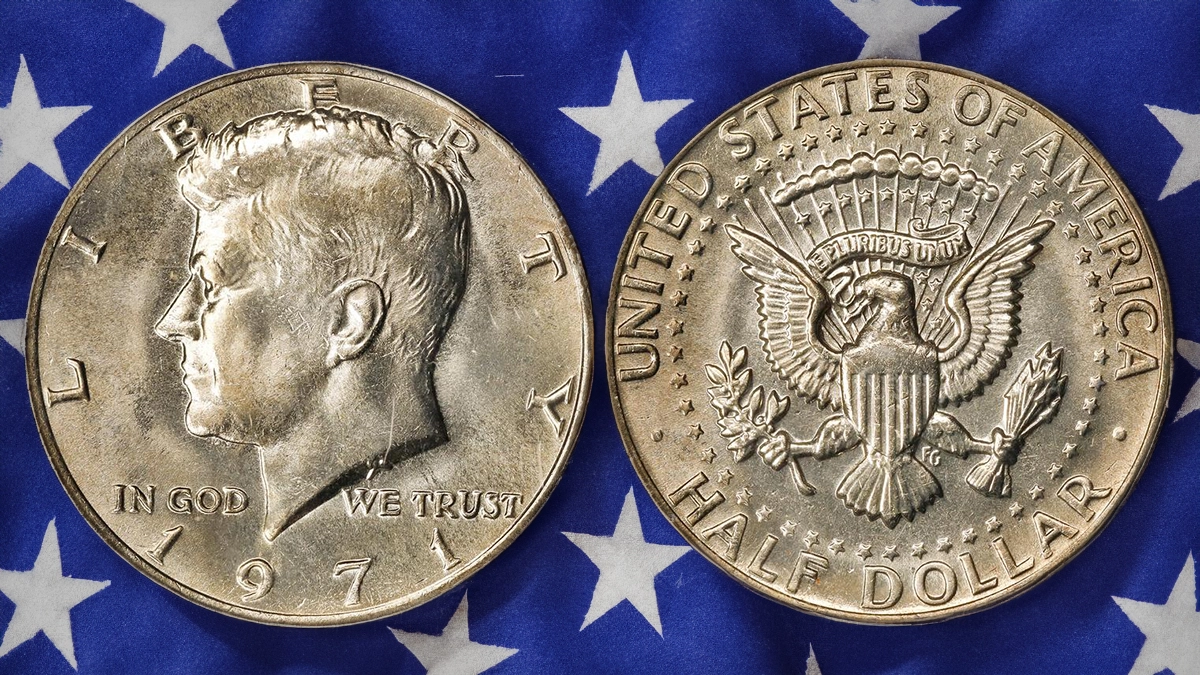
Kennedy Half Dollar, Clad (1971-Present)

The Kennedy Half Dollar debuted in 1964, just months after the 35th President was shot and killed in Dallas, Texas. The assassination put the country in a state of shock and the hurried effort to memorialize the slain President took place at the same time that the United States Mint was feeling the crush of demand for coins brought about by automation and an economy that had nearly doubled in size over the past 10 years. Silver as a circulating coin metal was doomed, and experiments were underway to find a suitable replacement.

Mintage reports from 1900-1960 reveal that the half-dollar denomination saw steady use in circulation. In the last year of the Franklin Half Dollar series, however, that steady output had ramped up to levels approaching 90 million coins. Demand for the quarter was more than double, and the Mint had struck more than 500 million dimes (dimes being the most frequently used coin for vending machines).

Demand for the 1964 Kennedy Half Dollar reached unprecedented levels as a wide swath of the American public wanted to obtain keepsakes. This only exacerbated the problems the Mint faced with its inability to outproduce demand. With the passage of the Coinage Act of 1965, silver coinage was discontinued, a date freeze was implemented, and the Mint began the process of producing a sufficient quantity of base metal coins to replace all of the silver coins that remained in circulation.

A carve-out for the Kennedy Half Dollar did not doom the denomination as is often said, but it did make half dollars struck between 1965 and 1970 more intrinsically valuable than the “equivalent” two clad quarters or five clad dimes. What truly did in the Kennedy Half Dollar was the vending machine industry. Similarly to how it neglected to adopt the Susan B. Anthony Dollar and the golden dollars of 2000 onward, the lack of vending industry support made the awkwardly sized half dollar inefficient.

When Congress authorized a change in composition to clad base metals for the 1971 issue, it failed to resolve the coin’s size, which was historically based on the value of the silver. Instead, the cumbersome coin fell out of use, and by the early 1980s, production for circulation fell below 30 million coins at the same time that the Mint was producing 1.2 billion quarters annually.

Two-Year Kennedy Half Dollar Bicentennial Reverse

The design of the Kennedy Half Dollar remained largely unchanged by the transition from 90% silver to 40% silver-clad, though the Mint’s engraving department made slight adjustments to the hubs to accommodate the harder planchets and increase striking pressure.

A major change to the design was undertaken, however, in 1975 and 1976 as part of the American Bicentennial. After a nationwide competition, artist Seth Huntington’s design featuring the rear facade of Independence Hall in Philadelphia and its bell tower was chosen to replace the Presidential Seal on the regular reverse.

Additionally, the date of the obverse was changed to read 1776-1976. The Philadelphia and Denver mints combined to strike over 500 million Bicentennial Half Dollars, a number inconceivable with today’s demand for the large 50-cent coin. Silver-clad and Proof half dollars were produced in much lower quantities for the collector market.

Today, getting at least one Bicentennial Half Dollar out of a roll or two of circulated Kennedy Halves is almost assured. Only coins in Mint State carry a premium over face value.

How Modern Clad Kennedy Half Dollars Are Sold

The Mint’s main customer is the Federal Reserve Bank, which orders various coin denominations to meet projected demand. From the Federal Reserve, coins are distributed to banks, which place orders for coins based on local needs. It’s a complex yet efficient system that has served the country well for decades.

As the Kennedy Half Dollar is an authorized coin of the United States, in any given year, banks could place orders for it in quantities sufficient to require the Federal Reserve to order the Mint to strike the coin for circulation. Nevertheless, demand in most years does not rise to this level. Instead, when the Federal Reserve gets half dollar orders, it tends to release coins from its stockpile of coins struck in previous years.

Therefore, the Mint usually strikes clad Kennedy Half Dollars only for its numismatic customers, who purchase them in Mint Sets, collector bags, and rolls. This means that it is near-impossible to acquire a complete set of clad Kennedy Half Dollars at face value through roll hunting. Collectors should obtain Kennedy Halves through Mint Sets (the best option as you get one of each coin struck for circulation at both the Philadelphia and Denver mints) or as singles. At a minimum, expect to pay between $2 and $3 per uncirculated coin. A complete set might run about $350 to $400.

Kennedy Half Dollar Clad Design

Obverse:

Gilroy Roberts adapted the Kennedy Half Dollar obverse from his work on Kennedy’s Inaugural Medal. Kennedy’s left-facing portrait is the design’s central motif. Wrapping around the upper portion of the rim is the word LIBERTY. The national motto IN GOD WE TRUST is inscribed in a straight line that extends from the left edge to the right edge of the coin, with “GOD” and “WE” separated by the truncation of Kennedy’s neck. The date wraps around the bottom of the design. Roberts’ initials appear on the truncation of Kennedy’s neck above the word “WE”.

Reverse:

Frank Gasparro adapted the Kennedy Half Dollar reverse design from the Seal of the President of the United States. A heraldic eagle is splayed, its chest protected by the Union shield. Clutched in its beak is a ribbon emblazoned with the motto E PLURIBUS UNUM. A glory of rays, clouds, and stars fans out from behind the eagle. The 13 stars represent the original British American colonies, while the rays and clouds signify heaven and the divine providence the founders believed inspired the formation of the United States. The eagle’s talons grip an olive branch in its dexter claw and a spray of arrows in its sinister. Fifty stars surround this central motif.

The legend UNITED STATES OF AMERICA wraps around the top of the design. The denomination HALF DOLLAR wraps around the bottom. Frank Gasparro’s initials FG appear between the eagle’s left leg and tail feathers.

Edge:

The edge of the Kennedy Half Dollar is reeded.
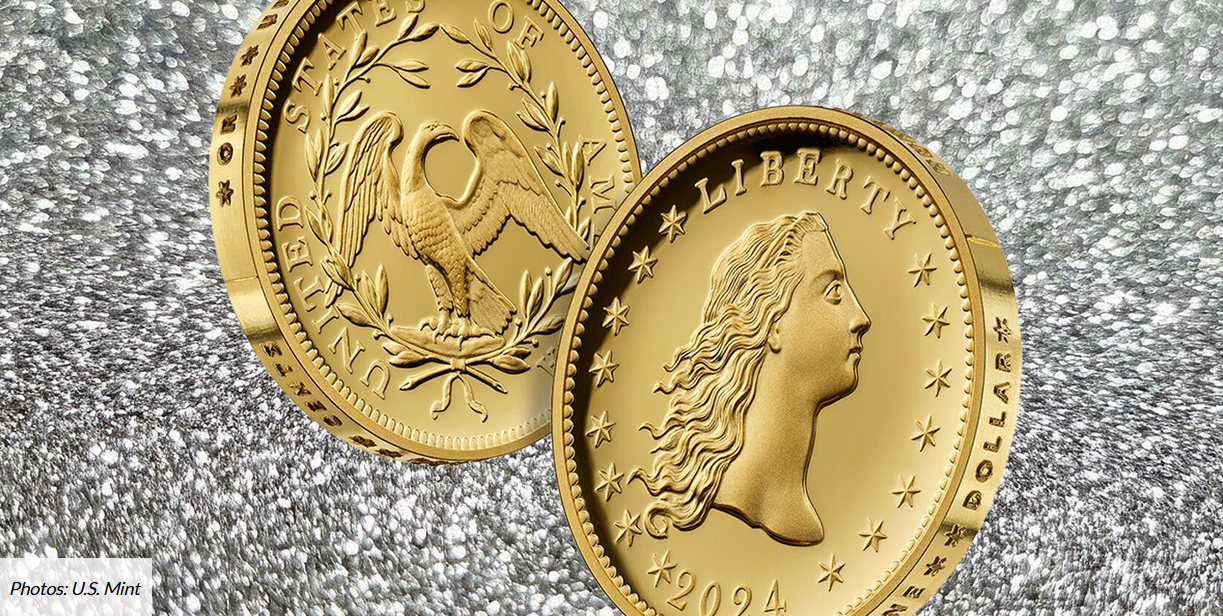
Did the Flowing Hair Dollars Sell Out?

The Proof 2024 230th Anniversary Flowing Hair High-Relief gold dollar, launched on November 14, is arguably the most important coin the United States Mint has produced since the 2009 Ultra High-Relief gold double eagle ($20).

That is because of the 1794 dollar’s history and the impressive way the mint has re-imagined the piece with 21st-century technology. It is undoubtedly one of the finest designs of all time, rendered exquisitely in high relief. In addition, the coin is the first laser-engraved piece ever to be struck by the mint.

As anyone who tried to purchase one when they went on sale online knows, they sold out in just four minutes. Many veteran buyers thought it was unlikely that the coining facility would sell the entire mintage of 17,500 for this piece at almost $3,700 so quickly.

In the weeks since, conflicting information has circulated within the numismatic community regarding whether this piece sold out, its actual mintage, and whether the mint will offer any more coins.

In advance of the start of sales, the U.S. Mint told Coin World’s Paul Gilkes that it had struck the full authorized maximum mintage of 17,500. It turns out, however, that they actually did not produce that many.

U.S. Mint Says Coin Is Gone

On December 2, in response to an inquiry for this piece, Michael White at the United States Mint confirmed that the coin has indeed sold out. He explained that while the mint could strike as many as 17,500 of these gold coins, they decided not to exercise that option. Instead, they limited the coin to only 10,000, making it one of the lowest mintage gold coins in modern U.S. Mint history.

Mr. White could not elaborate on why mint officials made only 10,000 of these trendy coins, adding that it was unrelated to a shortage of gold coin planchets.

The 10,000 coins sold include 2,000 reserved for sale to companies in the mint’s Authorized Bulk Purchase Program (with actual sales of 1,994) and 7,941 that were sold online on November 14 or since then (typically early in the morning), according to an updated figure from the U.S. Mint that Coin News provided on November 19. 

The 7,941 figure includes 500 coins sold on November 14 at the Whitman Baltimore Expo. In addition, the first 230 coins struck that feature a “230” privy mark will be sold on December 12 during a Stacks-Bowers auction.

Thus, total sales are about 9,935, which will likely change as orders are reconciled.

Silver Medals

A similar situation occurred with the silver medal, which had the same design as the gold coin. The 49,996 medals were sold online, and 10,000 were reserved for bulk sales. The medal has an authorized mintage of 75,000, but it seems the Mint also opted to make less than that amount of these.

Collectors now know they must purchase gold coins on the secondary market if they want one.

Grinch coins to be available in time for the holiday

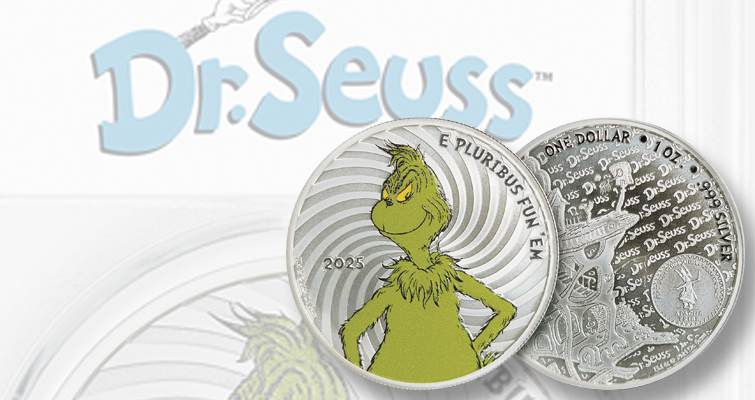
The first officially licensed Dr. Seuss coins depicting the famous green-colored Grinch from the popular book, How the Grinch Stole Christmas!, will be available starting on Friday, November 29.

While the day after Thanksgiving is commonly known as “Black Friday” for its holiday sales, this year the devious Grinch plans to “steal it” and make it “Green Friday” for the launch of his special, green-colorized coins.

The silver coins are 38.6 millimeters in diameter, slightly larger than U.S. silver dollars, and will be exclusively sold by Rare Collectibles TV.

“The Grinch is the first in a series of eight different limited edition legal tender coins depicting adored characters created by Pulitzer Prize-winning children’s books author Theodor Seuss Geisel. RCTV is delighted to be the exclusive distributor for these Dr. Seuss collectibles. It’s not just about collecting coins; it’s about collecting memories, too,” said Jack McNamara, co-founder of Rare Collectibles TV.

Mintage of the one-ounce .999 fine silver Grinch coins will be limited to 5,000, and each is being certified by Professional Coin Grading Service and encapsulated with specially created Dr. Seuss insert labels.

“RCTV’s goal is to keep the mintage figure incredibly low so collectors will own something truly special and rare,” adds McNamara. “Hopefully, Dr. Seuss fans will buy one for their kids, grandkids and maybe even their great-grandkids.”

For the first time since its founding in 1993, Dr. Seuss Enterprises has approved depicting the images of famous characters created by Theodor Seuss Geisel on legal tender collector coins. Geisel (1904-1991) published his first Dr. Seuss children’s book in 1937. He subsequently authored and illustrated more than 60 books, and over 600 million copies have been sold, according to Dr. Seuss Enterprises.

“Royalties paid for the use of the Dr. Seuss characters on the commemorative coins will help Dr. Seuss Enterprises benefit charitable organizations that focus on causes such as education, health, animal conservation, and the arts,” explained McNamara.

The book How the Grinch Stole Christmas! was first published in 1957 and the story has been adapted as television programs and theatrical films.

The obverse of the 2025-dated Grinch coins depict a green-colorized image of the furry Grinch with the humorous motto, “E PLURIBUS FUN ‘EM.” The reverse depicts the house illustration from the book, Oh, The Places You’ll Go!, and will be a common image used on all of the initial, collectible Dr. Seuss coins. The words “Dr. Seuss” are repeated in the background and “ONE DOLLAR 1 OZ .999 SILVER” are along the top and right rim.

A privy mark featuring the emblem from the Fort Sill, Chiricahua, and Warm Springs Apache Tribe is also on the reverse. The Native Americans tribe now based in Oklahoma is the sovereign entity issuing the Dr. Seuss coins that are being struck in the United Kingdom by The Commonwealth Mint & Philatelic Bureau.

Each coin will be accompanied by its own unique certificate of authenticity puzzle piece that when pieced together with the other COAs from each coin in this series will create an image of one of everyone’s favorite Dr. Seuss characters.

“Individual coins will be available while supplies last. We have also launched a Dr. Seuss Coin Club where members can automatically receive each of the eight classic Dr. Seuss character coins, such as The Cat in the Hat, one every other month. In addition, club members can automatically receive a ninth ‘mystery bonus’ character coin as a free bonus gift that will only be available to club members,” explained McNamara. “It is entirely possible that this ninth ‘mystery coin’ could become the rarest one of this first-time ever, limited-edition release.”

Working dogs to be recognized on commemorative coins

Congressional approval has been given for a commemorative coin program to recognize the critical contributions of working dogs in American society. The Senate passed S. 711, The Working Dog Commemorative Coin Act, on Nov. 19. The House of Representatives had passed their measure, H.R. 807, earlier this year. If signed by the president, the enactment would call for the creation of the coins in 2027. The measure was sent to the White House on Nov. 21.

All surcharges from the bill will go to America’s VetDogs to ensure that the organization can continue to provide these lifesaving animals to veterans and first responders with disabilities at no cost to the individual.

“Working dogs help our nation’s active-duty service members, veterans, and first-responders recover from injury, enhance their independence, and improve their lives,” said Senator Ted Budd, who introduced the measure in the Senate on March 8, 2023. “I commend the Senate and House for passing our bipartisan bill. This commemorative coin will honor the service of working dogs and provide funding to raise more service dogs for America’s heroes. I’m proud to lead this effort to give back to those who serve our country.”

“Working dogs are deeply embedded in our daily lives here on Capitol Hill and in those of countless veterans, active-duty military personnel, and law enforcement officers across the nation,” added Representative Patrick McHenry, who introduced the measure in the House on February 2, 2023. “I thank the America’s VetDogs team for their work to get this bill passed. Without the leadership of Senator Budd and the bipartisan collaboration from our colleagues across the aisle, this would not have been possible. The Working Dog Commemorative Coin Act is more than just a coin bill, it’s about improving the quality of life of our wounded veterans and first responders and honoring the service dogs who make that possible—something we all can get behind.”

“This legislation reflects what we can achieve together for a common cause,” said John Miller, CEO of America’s VetDogs.  “Each coin purchased will empower veterans and first responders to regain their independence, resilience, and quality of life. We are grateful to Senators Budd, Tillis, Kelly, and Duckworth, as well as Leader Schumer and Senator Gillibrand from our home state, for their leadership and bipartisan support.”

Under the terms of the measure, the Secretary of the Treasury would require the minting and issuance of not more than 50,000 gold $5 coins, along with not more than 500,000 $1 silver coins and not more than 750,000 clad half dollars. The measure calls for all products to be issued by one mint. The standard surcharges of $35 per gold coin, $10 per silver coin and $5 per clad coin would be added. The measure states all surcharges would be paid to America’s VetDogs for application to general expenses associated with the fulfillment of the mission of America’s VetDogs, including costs associated with personnel for training, dog care and consumer needs and other expenses in implementing the program.

For more than 20 years, America’s VetDogs has trained and placed guide and service dogs to provide independence, enhanced mobility, and companionship to veterans with disabilities from all eras. In 2015, VetDogs opened its programs to first responders, including fire, police, and emergency medical personnel. America’s VetDogs is a 501(c)(3) not-for-profit organization founded by the Guide Dog Foundation and serves clients from across the United States. More information can be found at www.VetDogs.org.

Rare coin found in piece of furniture sells for $2.52M at auction

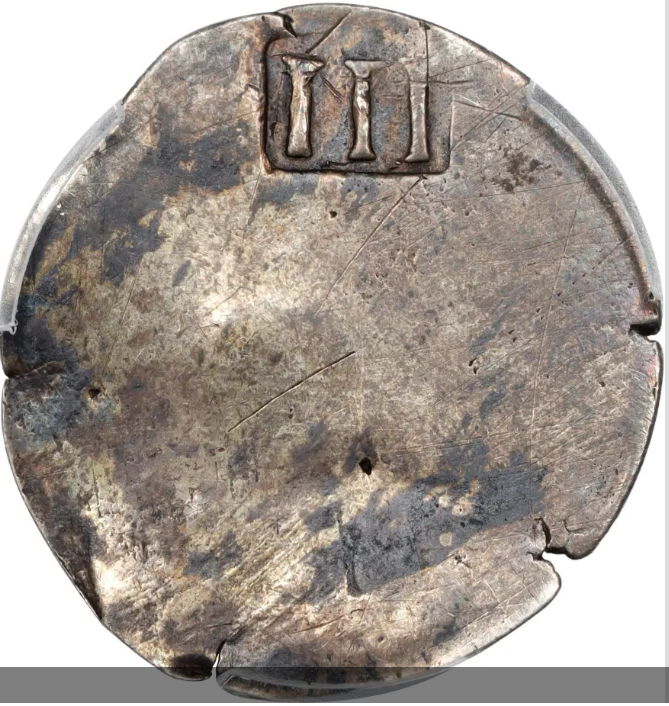
A rare 17th Century coin sold at auction for a record-breaking $2.52 million eight years after it was found in an old cabinet in Amsterdam.

The 1652 New England threepence, which is about the size of a nickel, was struck in Boston and found over three centuries later, inside an old cabinet in Amsterdam around 2016, according to a news release Monday from Stack’s Bowers Galleries, which handled the auction. The owner had no idea how valuable the discovery was for several years until he decided to thoroughly research the small, worn disk with three Roman numerals on one side and “NE” on the other.

Weighing just 1.1 grams, the value in silver was just $1.03 as of Monday’s market, but its rarity and rich history raised the price to a new record for any non-gold U.S. coin struck before the founding of the United States Mint, according to the gallery. The previous record was $646,250.

The threepence coin is thought to have come from the politically powerful Quincy family of Boston, which included the first lady of the United States, Abigail Adams, wife of President John Adams. Before serving as the second president of the United States, John Adams was also the fledgling country’s first ambassador to The Netherlands.

New England threepence coins are exceedingly rare – the only other known example has been in the care of the Massachusetts Historical Society for 120 years.

“This is one of the most important coins in all of American numismatics,” Professional Coin Grading Service President Stephanie Sabin told Coin World. “Since before the Civil War, collectors have regarded the 1652 New England threepence as the single-rarest American colonial coin. And for more than a century it’s been known as entirely unobtainable for private collectors.

The bidding war for the coin, which reached a price three times higher than initial projections, was “an exhilarating ride,” according to auctioneer Ben Orooji, who called the 12-minute contest “a career highlight.”

Money Doesn’t Grow on Trees

Almost everyone has heard the adage “money doesn’t grow on trees.” It seems like it has been passed down from generation to generation forever. There is great wisdom in the reprimand behind it. We should all be cautious about the way we spend our hard-earned money.

At the same time, there is a reverse side to the admonishment that is accurate from a numismatic point of view. Several related collector items have been made from wood and deserve a special place in our hobby. They may need a new name that doesn’t suggest they began life as a simple tree, and we should welcome them into our world of numismatic collectibles.  

Good on Paper

I like to think of them as “timber treasures” or “forest friends.” But kidding aside, many of our favorite collectibles are made from wood or wooden by-products. In the broadest sense, paper is often made from macerated tree pulp, and thus, many of our books, stamps, and paper money items should be recognized as having a woodsy origin. It is vitally important to realize this when storing and handling them.  

The original concept of using natural resources for what we today call paper products likely began centuries ago in China, where paper was used for writing, printed materials, and various other practical purposes. Ancient Egyptians used marsh-reed papyrus similarly, and today, the paper manufacturing industry provides us with a vast array of plant-based specialty products catering to our many needs. 

Since the advent of the printing press in the 16th century, most low-cost books have been printed on paper made from either wood pulp or rag linen. More costly items were sometimes made of parchment or animal hide, but because of their stability, storing and handling those are usually not a problem for collectors. 

What concerns numismatists is that wood-based paper products eventually dry out and crumble with age. Linen-based paper is far superior and has a much longer shelf life. This is especially noticeable when comparing 18th-century Continental Currency made from linen with inexpensive wood-based private bank notes of the mid-19th century. Proper handling of all these items is essential for preserving them in today’s often unstable environment. Exposure to some kinds of light can be detrimental, and collectors should take care to keep those items away from bright light for any longer than necessary. Exposure to sunlight can be especially dangerous.

All valuable paper products should be handled with care. This especially applies to rare books, which can be severely damaged unless carefully opened with cloth-gloved hands. Small, flat paper documents and paper money should be stored in archive-quality holders. Polyethylene terephthalate-based Mylar and Mylar-D plastics are considered the most reliable for paper money. I recommend that you avoid vinyl products, which decompose with time.

Non-Paper Collectibles

Of course, books and paper money are not the only wood-based items that appeal to collectors. Many coins, tokens, chits, checks, and medals have been made from wood throughout the ages. It is an exciting challenge to hunt for them among the specialized dealer inventories that can often be found at coin shows. 

Several attractive commemorative medals have been made of compressed wood and are among the most sought-after wooden collectibles. Tally sticks, often made from strips of wood, are also highly desirable, especially those used in medieval England as a pledge of money to be paid to the royal treasury. Many of these were sometimes used in secondary transactions as promissory notes. 

The most common wooden collectibles are the ubiquitous wooden nickels, which abound in every shape and form, from the early “flats” of the 1930s to the round dollar-size pieces seen so frequently today. One of my favorites was issued in 1952 on the anniversary of the so-called “tree” coins of New England. 

So, money might not grow on trees, but trees are essential to the creation of many collectibles that hobbyists love.

An introduction to coin collecting for beginners

Coin collecting dates back to the 12th century, and it remains a popular hobby for people of all ages around the world.

Commonly known as ‘numismatics’ by enthusiasts, there are many different reasons for starting a coin collection.

One of the cheapest ways to begin collecting is by saving specific £1, £2 or 50p coins which are found in pocket change. After all, they’ll never lose value and can be spent if you grow tired of the hobby.

For some collectors, the thrill comes from holding a beautiful piece of craftwork in the palm of their hand, where they can fully appreciate its age, weight and history.

For others, coin collecting is far more than a hobby, it’s a way of life. Rare artefacts are sought-after, sometimes by using metal detectors, and cherished for their beauty and scarcity.

It doesn’t matter why you’re interested in numismatics, this introduction to coin collecting will help you learn a few basic rules so you can create a collection you’ll be proud of.

Image credit: usmint.gov

The basic parts of a coin

Before starting a collection, it’s important to familiarise yourself with the basics – such as the different areas of a coin.

The head: Also known as the ‘obverse’, this side usually has an image of a bust or portrait and the year when it was minted.

The tail:Also known as the ‘reverse’, this side features the coins face value.

The rim: The raised-up area which encircles the diameter of the obverse and reverse sides.

The relief: The part of a coin’s design which is raised above the surface.

The edge: Sometimes known as the ‘third side’, this is often grooved but can be ornamental or plain.

The legend: The lettering or inscription which identifies the country of issue and its face value. It may feature the initials of the designer.

The field: Any flat surfaces of areas with no inscriptions, which provides the background for the coin.

The different types of coins

When you’re just starting out in numismatics, you probably won’t know all the different types of coins available to collect.

Here are some the most common types you’ll come across:

Error coins: Any coin with a flaw which distinguishes it from other similar examples. These are often extremely rare, difficult to acquire and carry a high price tag.

Proof coins: Specially minted for collectors and prized for their distinguished visual appeal. They have immaculate design and finish made to the highest quality. The pinnacle of coin collecting.

Brilliant Uncirculated coins: Coins with a fine mint appearance and lustre because they’ve never been in circulation. Slightly lower in definition to a proof coin.

Commemorative coins:Issued to mark a special event or tribute to an important person, Commemorative Coins can often prove to be valuable in their own right.

Bullion coins:Coins crafted from precious metals such as gold, platinum and silver.

Ancient coins: Exceptional pieces of history, often handmade, which can date back to Roman or Greek times.

Circulating coins or business strikes:The coins in general circulation for daily use.

Worldwide coins: Any coin which is from a country which is outside the UK.

How to start a coin collection

With such a wide range of coins available, starting a collection can initially feel a little overwhelming.

Before spending money on coins, learn everything you can about them. Start with the loose change in your pocket and familiarize yourself with their parts, inscriptions, images, the material it’s made from and what type of coin it is.

Having mastered the basics, you’ll soon be able to weigh up the best approach for compiling your collection.

Collectors usually choose to specialize in one of four principal categories:

Theme

Collecting by theme is probably the most common way to get started with numismatics – the possibilities are endless. Simply choose a topic which has been depicted on a coin and away you go. It could be an imaginary character, famous person, animals, cars, railways, flowers, buildings, landmarks, sport or sporting event. Perhaps unsurprisingly, the most popular coin collecting theme in the world is the Olympic Games, closely followed by football and military history.

Image credit: Royal Mint

Historical significance

Historical enthusiasts love to collect coins which relate to a specific period. You may be interested in a time period (e.g. WW2 from 1939 to 1945) or a year which has significance for you, such England’s World Cup win in 1966. Perhaps you could acquire each coin issued from one particular year, like the Crown through to the Farthing, before doing the same for another year. Collecting coins with different mint marks is also another interesting way to collect by year.

Type or denomination

If you choose to collect based on a coin’s value, it opens the possibility of acquiring every major design ever featured, such as those on a Penny or Farthing. Or you may want to collect all the year types or different mint marks.

Country of origin

If you want to learn about the culture and history of a country, collecting coins is a great way to do it. British coins are obviously very popular, but those issued in Canada and America also offer great insight into their Presidents and historic periods like the Gold Rush, Civil War or Wild West era.

What’s your motivation for collecting?

When starting out on this fantastic journey, it’s important to understand why you’ve been motivated to do so.

Here are some of the most common reasons we’ve come across:

  • Interest passed from one generation to another
  • Interested in certain themes (queens, wars, sport, films etc)
  • Enjoy the visual reference coins offer
  • Found an interesting coin by chance
  • Save foreign coins from trips abroad
  • Admire coins for their artistic value
  • Like following work of the Royal Mint
  • Collect for their bullion value
  • See it as a long-term investment

Although there’s no right or wrong answer for starting a coin collection, unlocking the secret may help to shape your thoughts and collecting habits in the long term.

In our experience, the golden rule of collecting is to only acquire coins that you like or find interesting. Stick to this principle and you’ll never grow tired of your new-found hobby.

If you’re keen to learn more about old coins, see our Coin Grading guide for more information!

How to store coins

Coins may be made from metal, but they can easily get damaged so it’s important to handle and store them well.

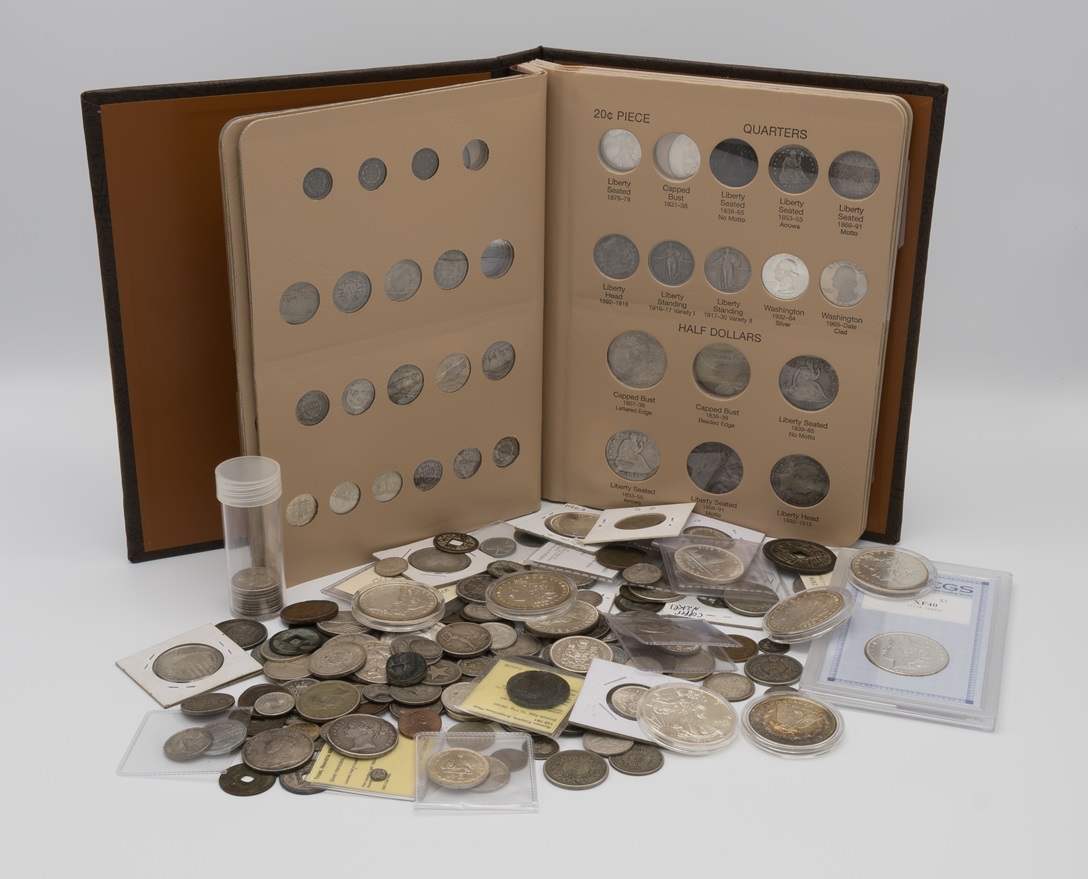
When starting out your coins are likely to be of lesser value, and the easiest way to store them is by putting them in a coin tray (pictured below) or cabinet.

Image credit: Amazon sell coin trays

If you begin to acquire coins which are more valuable, they’ll require a better storage solution.

Coin envelopes, made from acid-free paper, are ideal for storing single coins. Special air-tight envelopes or albums can be used to store or display a collection of individual coins, preventing oxidation or scratches.

How to clean coins

There is a proper way to clean coins and using the wrong method can often reduce its value.

At Warwick & Warwick, we do NOT advise cleaning a coin unless it is absolutely necessary.

If you really do want to clean a coin, consult a numismatic expert to do it on your behalf. But never use chemicals or abrasive cleaning products on coins.

Collect, learn and enjoy – a summary

It doesn’t matter whether you want to collect for pleasure or treasure, this enthralling hobby can very quickly get a grip of you.

When starting out, very few collectors actually know what types of coins they want to collect. Most begin by buying a wide range of denominations or types until they find a specific area of interest.

As with any hobby or specialism, novices are more inclined to make mistakes compared to collectors with more experience. But this is not something beginners should worry about.

However, you should think long and hard before buying any coin. Is it the type you like and within a price range you can afford? If you answer ‘no’ to either of these, it’s probably not the right one for you.

Depending on your budget, it’s always wise to try and buy the best quality coin you can afford at the time. In the long run, adopting this attitude will reap its rewards. After all, it’s usually better to own a few valuable coins which are of interest to you rather than a larger collection which fails to capture the imagination.

Remember, coin collecting should be an enjoyable experience. Take your time, do your research and learn about all the different coins which are available. It may take months or years to amass a collection – and coin knowledge – that you’re proud to display.

The History and Significance of the American Silver Eagle Coin

The American Silver Eagle coin is one of the most iconic and sought-after silver coins in the world. First introduced in 1986, this coin has become a staple for collectors and investors alike. Its blend of historical significance, beautiful design, and intrinsic value makes it a fascinating subject for anyone interested in precious metals. This article explores the history, design, and importance of the American Silver Eagle coin, shedding light on why it holds such a revered place in the numismatic world.

The Origins of the American Silver Eagle

The American Silver Eagle was born out of a combination of economic and political factors. The idea of a new silver bullion coin was first proposed in the early 1980s as a way to dispose of the massive stockpile of silver held by the U.S. government. During this time, the federal government had accumulated large quantities of silver, particularly as a result of the Defense National Stockpile Center’s purchasing programs. By the 1980s, it was determined that these stockpiles were no longer necessary for national defense, and a plan was needed to liquidate them.

The result was the Liberty Coin Act, signed into law by President Ronald Reagan on July 9, 1985. This legislation authorized the production of the American Silver Eagle, with the first coins being minted and released in 1986. The United States Mint was tasked with the production, and the coin was quickly embraced by both investors and collectors.

Design of the American Silver Eagle

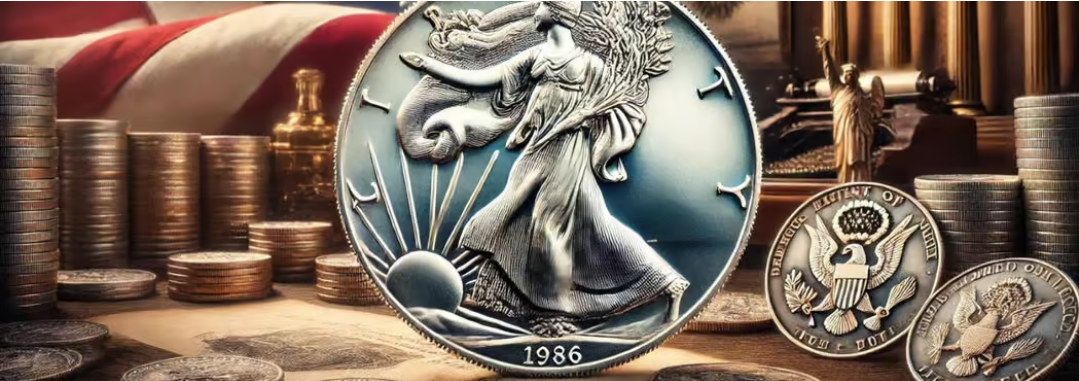
One of the most striking features of the American Silver Eagle is its design, which combines historical imagery with modern aesthetics. The obverse (front) of the coin features the Walking Liberty design, originally created by sculptor Adolph A. Weinman for the half-dollar coin minted from 1916 to 1947. The Walking Liberty design is widely regarded as one of the most beautiful in American coinage history, and its inclusion on the Silver Eagle pays homage to this classic design.

The obverse depicts Lady Liberty striding towards the rising sun, draped in the American flag, with her right hand extended and a bundle of oak and laurel branches in her left hand. The image symbolizes freedom, strength, and hope, resonating with the ideals of the United States.

The reverse (back) of the coin, designed by John Mercanti, the 12th Chief Engraver of the U.S. Mint, features a heraldic eagle behind a shield, clutching an olive branch in its right talon and arrows in its left. Above the eagle are 13 stars, representing the original 13 colonies. This powerful imagery evokes the nation’s strength and readiness to defend its freedom while also symbolizing peace.

Minting and Specifications

The American Silver Eagle is struck in one troy ounce of 99.9% pure silver, making it a substantial and valuable coin. The coin has a diameter of 40.6 mm, a thickness of 2.98 mm, and a face value of one dollar, although its market value is much higher due to the silver content and its collectible status.

The coins are minted in three different versions: bullion, proof, and uncirculated. The bullion version is intended for investors and is sold at a small premium over the spot price of silver. Proof coins are struck with a high-polish finish and are targeted at collectors, often sold in special packaging. The uncirculated version is also aimed at collectors and features a matte finish.

The American Silver Eagle has been minted at various U.S. Mint facilities, including Philadelphia, San Francisco, and West Point. Each minting location sometimes places a small mint mark on the reverse of the coin, such as a “P” for Philadelphia, an “S” for San Francisco, or a “W” for West Point, helping collectors identify the coin’s origin.

The Significance of the American Silver Eagle

The American Silver Eagle holds significant importance in both the investment and numismatic communities. For investors, it represents a tangible asset that serves as a hedge against inflation and economic uncertainty. Silver has historically been a store of value, and owning American Silver Eagles allows individuals to hold physical silver in a form that is easily recognizable and tradable.

For collectors, the American Silver Eagle is a piece of modern American history. The coin’s design connects it to the broader history of U.S. coinage, particularly with the use of the Walking Liberty motif. Collectors often seek out different versions of the coin, including those with special mint marks, low mintages, or unique finishes, making the Silver Eagle a central piece in many collections.

The American Silver Eagle has also been used to commemorate significant events. For example, in 2021, the U.S. Mint released a special version of the coin to mark the 35th anniversary of the series. This version featured a new reverse design, showcasing an eagle in flight, symbolizing the ongoing legacy and evolution of the coin.

Collecting and Investing in American Silver Eagles

Collecting American Silver Eagles can be a rewarding endeavor. The coin’s consistent quality, combined with its beautiful design and historical significance, makes it a favorite among collectors. Additionally, the wide range of options from bullion to proof and uncirculated versions provides opportunities for both novice and experienced collectors to build a collection that suits their interests and budgets.

For investors, the American Silver Eagle offers a way to diversify a portfolio with physical silver. The coin’s liquidity, coupled with its global recognition, ensures that it can be easily bought or sold in the marketplace. Many investors also appreciate the coin’s role as a hedge against inflation and economic instability, providing a sense of security in uncertain times.

Conclusion

The American Silver Eagle is more than just a silver coin, it is a symbol of American heritage, artistry, and economic resilience. Whether you are a collector drawn to its beauty and history or an investor seeking a reliable store of value, the American Silver Eagle offers something for everyone. Its continued popularity and significance in the world of precious metals ensure that it will remain a treasured piece of American coinage for generations to come.

Gold prices smash another record: What gold assets should you buy now?

Gold’s price performance in 2024 has been extraordinary. The upward price surge first started in early March when the price of gold hit about $2,160 per ounce, and since that time, gold’s price has shattered records almost continuously. In total, gold’s price has climbed by about 33% since January 1, 2024 — and the price of gold just shattered another record this week, reaching $2,776.10 per ounce, a new peak in an already remarkable bull run. 

For early investors, this year’s meteoric rise in gold prices has led to impressive returns. Those who bought gold at the $2,160 price point in March have already enjoyed substantial gains and even recent investors who entered the market at slightly higher levels have benefitted from the upward trend. This surge has also brought renewed attention to gold as an asset, not only as a long-term investment but as a tool for turning a quick profit in the current market. 

If you’re contemplating entering the gold market amid these soaring prices, though, it’s important to make strategic choices on what you invest in. In this environment, certain gold assets may offer bigger advantages than others — so you’ll want to pick your gold investments wisely. 

Reference: CBSNews

The Top 10 Best Gold Coins to Buy for Investment

When looking for investment options, gold coins should rate at the top of your list. It is, arguably, the best option for collectors and investors alike. Gold provides physical, easily liquidated assets and is indispensable in engineering and electronics, as well as the health, environmental, and jewelry industries. In coins, rounds, and bars, gold promises to be in constant demand.

According to the World Gold Council, “The modern gold market is a picture of diversity and growth.” The council claims that gold production has tripled since the early 70s. Meanwhile, the amount of gold purchased annually has quadrupled.

Gold resists corrosion, can be stored in a relatively small space, and holds its value well. Additionally, investors need not pay capital gains tax on gold purchases – only upon sale.

We recommend purchasing one-ounce coins for the lowest premium above Spot price, but many coins below come in smaller versions as well.

Gold American Eagle Coin

Available in one-tenth-ounce, quarter-ounce, half-ounce, and one-ounce coins, the American Gold Eagle should be at the top of your “must-have” list. It was designed and first minted in 1986 and has stood the test of time. The American government releases a limited number of these coins per year. You can purchase them as proofs, uncirculated coins, or proof sets.

The American Eagle contains 91.67 percent gold (22 karats), 5.33 percent copper, and 3 percent silver. The U.S. Government guarantees the weight, content, and purity of these coins, making the American Eagle one of the most popular investment coins you can buy. They are easily valued and highly liquid.

While the spot price of gold determines the value of any investment coin, they also carry a legal tender value ranging from $50 for the one troy-ounce coin to $5 for the one-tenth-ounce piece. The American Eagle is also available in silver.

The coin’s face features a strong Lady Liberty, her hair tumbling in a brisk wind. She holds her torch high in her right hand and has an olive branch in her left. She stands before the Capitol building on a field of rays. Stars march around the outer edge of the coin. The face of the coin shows the year it was minted.

The reverse side holds a touching vignette of a family of eagles. The male furls his wings, preparing to land in his nest where his mate and their hatchling await. He holds an olive branch in his claws.

American Eagle coins are scheduled to be redesigned in 2021 to introduce more up-to-date counterfeiting measures, making this coin an even better investment.

Canadian Gold Maple Leaf

The one-ounce Canadian Maple Leaf gold coin is one of the most secure investments in the world. This security allows the stunning Canadian Gold Maple Leaf coin to give even the Gold American Eagles a run for their money.

The award-winning Royal Canadian Mint is always on the cutting edge of technology. Bullion DNA (Digital Non-destructive Activation) technology, introduced in 2013, is one of their most significant advances.

This technology consists of micro-engraved images on the face and reverse of their 1-ounce gold bullion Maple Leaf Coin. The Mint takes high-resolution photos of every one of these beautiful coins, storing them on secure servers. A special reader, released only to authorized dealers and distributors, allows real-time authentication of one-ounce Maple Leaf coins struck after 2013.

These anti-counterfeiting measures have boosted buyer confidence. The Mint has subsequently begun striking one-ounce silver and one-ounce platinum Maple Leaf coins with the same technology.

Made of .9999 fine gold, the Canadian Maple Leaf is available in fractional sizes up to five ounces.

On its face, the coin displays a right-facing bust of Queen Elizabeth in pearls. The reverse features a single maple leaf, Canada’s national symbol.

These coins are guaranteed by the Canadian government, making the Canadian Maple Leaf gold coin a solid investment for beginners and experts alike.

American Buffalo Gold Coin

The American Gold Buffalo is the first 24-karat coin minted in the United States. It was released by the U.S. government in 2006 which required the coins to be minted from gold mined in America. It gets its classic looks from the original James Earle Fraser design for the Buffalo Nickel. This design was commissioned in the 1900s by President Franklin Roosevelt.

American Gold Buffalo Coins

Its face holds the austere, aquiline features of a Native American Chieftain with two feathers tied high in his hair. On the reverse is the proud profile of an American Buffalo gazing westward.

The U.S mint released the Buffalo coin to compete with the Canadian Maple Leaf, the Austrian Philharmonic, and other 24-karat coins available to collectors and investors alike. The coin’s purity (.9999 fine gold) makes it softer than the American Eagle. Handle with care to avoid marks and scuffs in the metal.

The Gold Buffalo carries a face value of $50. However, this uniquely American coin — printed on gold mined in the United States, stamped by an American Mint, and backed by the United States government — is a stable value for discerning investors.

Author: Clint Siegner

Back to Top
Product has been added to your cart